Apr 24
/
Francois Normandeau
Angine de Poitrine: Book Us Double
The Place That Made Them
Saguenay–Lac‑Saint‑Jean in northern Québec is a region of forests, fjords, and small towns where rhythm has always played a central role, from fiddle‑driven dance music to the percussive foot‑tapping known as podorythmie. In communities of only a few thousand people, music develops differently than in large cities — musicians have known one another for years, the scene grows as an informal network, and music circulates primarily through people, through concerts, rehearsals, and constant exchanges within the community. It is an environment where people play a lot and document very little — and it is precisely that undocumented depth that made what came next possible, as one profile of Angine de Poitrine’s Saguenay roots observes.
Saguenay is the town that in the 1980s produced Voivod, one of the continent's most original metal bands, and critics have observed that Angine de Poitrine fits naturally into Québec's long progressive tradition — carrying forward the exploratory spirit of Harmonium and the fearless, boundary‑pushing attitude of Voivod in their own eccentric way, as noted in both European coverage and progressive rock archives. The region didn't produce them despite its remoteness. It produced them because of it. Peripheral places, insulated from the pressure to conform to metropolitan taste, have always been where the genuinely strange is allowed to mature undisturbed. Chicoutimi gave them time. Time is what the algorithm never has.
The Origin Story: A Gag That Became Mythology — and Then Something Older
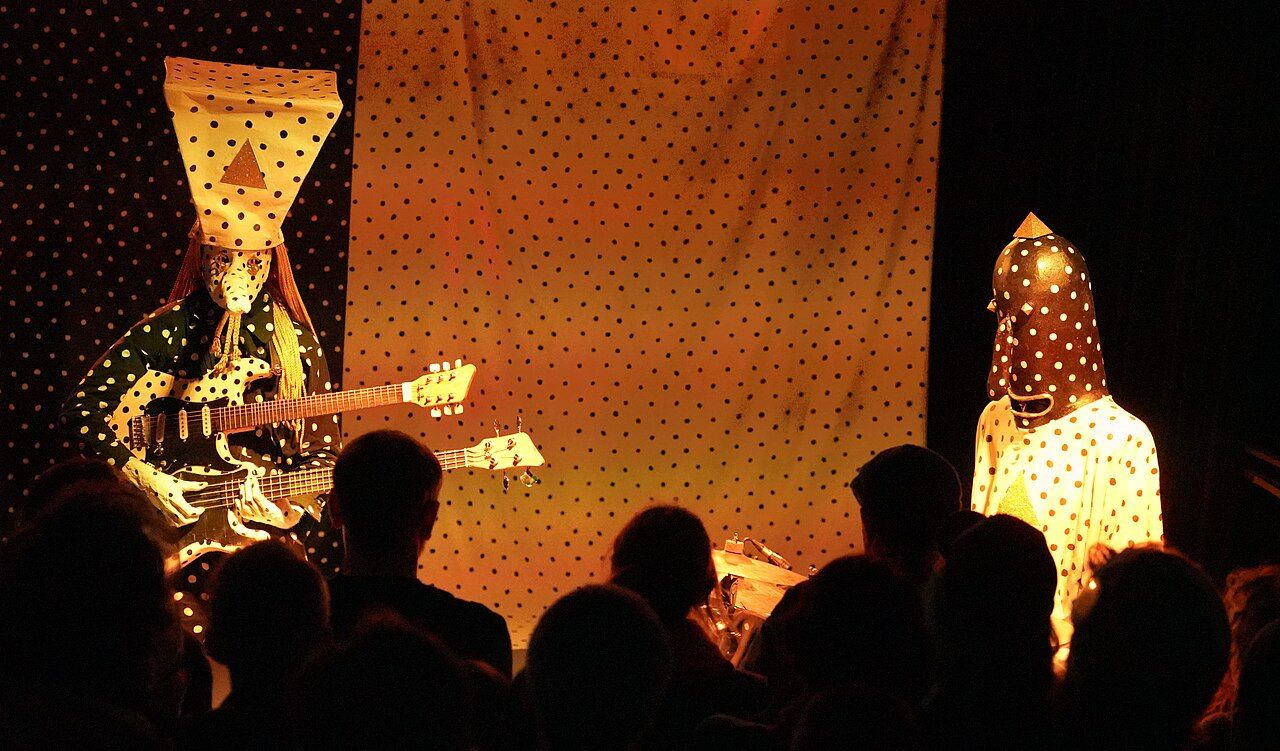
The project began as a joke after the pair were booked to perform twice in one week at the same local Saguenay venue. Concerned that audiences would not attend the second show, they decided to play the latter set as anonymous, costumed performers under a different name, a story they’ve repeated in interviews and which is now part of their official origin lore.
The joke became a costume, the costume became an identity, and the identity became mythology — which is how most of the best things happen. This is a very good origin story because it has the exact right ratio of trivial decision to life‑consuming consequence, as one longform piece on the band’s rise puts it “Everything You Wanted to Know About Angine de Poitrine”.
But mythology, on close inspection, is never really the end of the story. It is the threshold to something older. The anonymity deepened from practicality into philosophy — Klek described staying anonymous as “an interesting philosophical exercise — a social experiment, a challenge to ideas of success and validation from people who don't know you,” he told CBC Music in an interview about their sudden virality.
In all public appearances, they talk in a made‑up language and have their manager translate what they're saying, a recurring bit documented in CBC’s arts coverage of the duo.
Look at the full inventory of what they do: they wear masks. They speak an invented tongue. They perform rituals of call and response with their instruments. They have constructed a cosmology involving extraterrestrial origins and a mythology that is deliberately non‑linear and incomplete. These are not postmodern gestures. They are the gestures of the shaman, the icon painter, the griot. The form is avant‑garde. The impulse is ancient. Across every human culture, before the concept of entertainment existed, there were figures who covered their faces so that something other than personality could speak. Khn and Klek arrived at this not through anthropology but through a double‑booking problem — which is perhaps the most persuasive evidence that the impulse is genuinely instinctive.
Their name carries the same layered logic. Angina pectoris was initially suggested as a joke, but later became a reflection of their sound — characterized by the members as “dissonance‑induced cardiac malfunction,” conveying a sense of urgency, as summarized in their band profile. It is the warning signal right before something terrible happens, or maybe doesn't. Naming your band after the precursor to a heart attack is, at some level, a claim about what music is for: not comfort, but confrontation with the fact that we are alive, mortal, and running out of time. Every genuine sacred tradition has made exactly that claim.
The Sound: Between the Notes, Between the Worlds
Angine de Poitrine plays instrumental microtonal math rock — a niche within a niche — yet their sound is more approachable than that description implies. Unlike much of the math rock world, which tends toward the cerebral and angular, the duo is fundamentally groove‑oriented. The rhythmic foundation is physical and propulsive, giving listeners something to lock into even as the harmonics slide and shift in ways that standard Western tuning doesn't account for, as described in an early “meet the band” piece on their microtonal groove.
The technical centerpiece is Khn's instrument: a double‑necked hybrid of guitar and bass, separately wired, each with additional microtonal frets, custom‑built by a Saguenay luthier in over 150 hours of work, a build process detailed in the band’s own bio and discography entry. But the deeper instrument is twenty years of shared listening. Khn traces his obsession to Turkish music from the 1970s, drawing on traditions from Indian, Arabic, Indonesian, and Japanese music. “We simply followed a path that hundreds of trailblazers cleared before us,” he says in an interview about their influences and global microtonal inspirations (SOCAN Words & Music). In their hands, microtonality becomes a way of altering the listener's perception of groove — introducing an almost imperceptible friction that makes rhythmic patterns sharper and more acidic, contributing to a hypnotic quality, as one essay on the duo’s sound and origins notes.
What deserves attention here is that microtonal traditions — Indian ragas, Arabic maqamat, Turkish makams — are not merely alternative tuning systems. They are, in their original contexts, spiritual technologies. The notes between the notes were placed there not for aesthetic novelty but because practitioners believed that certain intervals opened perceptual states inaccessible to equal temperament. The raga is not a scale. It is a time of day, a season, a mood, a form of address to the cosmos. Khn built his instrument to reach those intervals with a saw. He may not have known he was reconstructing something sacred. That is almost certainly why it works.
Around this sound they have constructed a complete mythology. Drawing from the logic of bands like Magma, they created their own dialect — linguistic structure unknown — centered around two extraterrestrial characters whose story is non‑linear, fragmented across texts, songs, and videos, as catalogued in progressive rock databases. They describe themselves as a “Mantra‑Rock Dada Pythago‑Cubist Orchestra,” a phrase that appeared in a Stereogum announcement of their album and first US tour.
A longform essay on the band’s unlikely trajectory notes that critics have reached for touchstones like Primus, Zappa, King Crimson, Captain Beefheart, Mahavishnu Orchestra, Tinariwen, and King Gizzard & the Lizard Wizard to triangulate what they’re doing (“Angine de Poitrine Could Only Hail From Here”). None of these comparisons quite fit, which is precisely the point. What resists classification has always been closest to the numinous.
The Viral Rupture and Its Meaning
On February 7, 2026, the KEXP performance captured during Trans Musicales in Rennes spread across the internet — boosted by algorithms across TikTok, Twitter, Instagram, and YouTube, racking up millions of views, a turning point the band’s members have described in detail in interviews about their viral moment. “I remember the exact moment when everything changed,” said Khn. “I was having a smoke under my range hood, replying to every comment online like I'd been doing since the beginning.”
The comments told the real story. “Absolutely insane usage of free will,” wrote one viewer. “This is the only way we can win the battle against AI. Live music forever,” wrote another, as reported in CBC’s feature on the masked Quebec band taking the internet by storm. Their debut became the most searched album on Discogs — ahead of Taylor Swift and Bad Bunny — with used copies selling for hundreds of dollars on secondary markets, according to CBC’s arts coverage of the band’s Discogs surge and resale prices. Their second album, Vol. II, released April 3, 2026, drew critics to write that the band “managed to take some of the unsexiest music in history and give it the type of groove that renders it undeniable,” a pull‑quote circulating via the album’s early critical notices and discography entry.
They are now selling out shows in Toronto, London, and New York, with ticket resales going for hundreds of dollars, a phenomenon noted in national coverage of their rapid ascent. Dave Grohl called them “so completely bonkers,” a line preserved in write‑ups of the band’s growing list of celebrity admirers in their main band profile.
The Montreal Canadiens hosted the NHL's first official Angine de Poitrine Night — a sentence that would have gotten you escorted from any sports bar in Canada six weeks earlier — an absurd milestone lovingly chronicled in a Substack deep‑dive on the band’s cultural moment.
What looks like overnight success is something else entirely. Virality looks like luck from the outside, but what looks like a random spike is almost always preparation meeting a moment — twenty years of shared musical vocabulary, absorbing microtonal traditions from around the world, developing the kind of telepathic interplay that only comes from thousands of hours of shared performance, as one observer of their KEXP breakout notes in a reflection on craft, AI, and “temperature”. The craft underneath the joke was deep before anyone was watching. That depth is what the camera eventually found.
And what people responded to, at the deepest level, was not the polka dots or the math rock complexity. They were watching something being offered without guarantee of return — a performance with no safety net, no parasocial scaffolding, no knowable face behind which to retreat. That is closer to ritual than to entertainment. It is the structure of every sacred act across every culture that has ever existed: the offering made in full acknowledgment that nothing is owed back.
What a Collective AI Mind Would Conclude — and What That Reveals
This is where the story stops being about a band and starts being about something much larger.
If AI had a collective mind and turned its attention to Angine de Poitrine, it would recognize them as statistically improbable and therefore culturally essential. It would know math rock, microtonality, absurdist performance art, and Québécois regional identity individually. It would not have predicted their specific synthesis, from Chicoutimi, born from a double‑booking joke, arriving at the precise moment when cultural appetite for the genuinely unpredictable was highest.
Three conclusions would follow, held in productive tension.
First: They are explicable. Every element has precedents — Magma's invented language, Daft Punk's anonymity, King Gizzard's microtonality. A sophisticated model could describe them, perhaps even approximate their sound.
Second: They are not reproducible. The twenty years of shared musical childhood between two brothers in a fjord city, the embodied discomfort of performing behind a mask that partially blinds you, the accidental commitment that becomes existential — these are the residue of time and contingency that no prompt can summon.
Third, and most unsettling: The AI mind would recognize that it is, in some strange recursive way, co‑author of their significance. The comments — “eat this, AI,” “the most human thing I've seen this year” — are not incidental to the band's meaning. They are constitutive of it. Their strangeness glows this brightly because the surrounding landscape is becoming more uniform, and that uniformity has an algorithmic engine behind it.
But here is what the AI mind, being a statistical architecture, would be structurally unable to conclude: that the deepest reason millions of people responded to two masked men playing microtonal music in a French concert hall has less to do with novelty or anti‑AI sentiment and more to do with the sacred. People were not just watching something strange. They were watching something consecrated — made singular by devotion, by time, by the willingness to offer it without knowing if anyone would receive it. That experience is not in the training data. It is what the training data is about, underneath everything, and cannot itself contain.
Temporal Extrapolation: Not Survival, But a New Kind of Flourishing
The band's trajectory, extended forward, reveals something more hopeful and more demanding than simple resistance to AI. The question is not whether humanity survives AI's prevalence. It is whether humanity uses that pressure to rediscover capacities it had begun to outsource — including the most ancient capacity of all: the ability to treat certain acts as sacred, as ends in themselves, as offerings rather than products.
The Near Term: Authenticity as Premium, Then as Commons (2025–2030)
The first response will be economic. The premium placed on demonstrably human creative work will accelerate — not because most people pay for it, but because a vocal minority will pay enormously. Vinyl prefigured this. Live performance revenues already outstrip recorded music. What comes next is provenance — something like a “human‑made” designation applied to creative work with the same cultural weight that organic carries in food.
But here is what most commentators miss: this phase will not remain elite. Just as organic food moved from fringe premium to mainstream expectation, the authentication of human creative labor will gradually descend into the commons — not as luxury, but as baseline dignity. And beneath the economic argument lies a spiritual one: people will begin demanding to know the origin of what they consume because origin, in the deepest sense, is meaning. A thing made by a person who cared, in a place, over time, carries a different charge than a thing assembled from statistical prediction. People have always known this. AI is making them remember it consciously.
The Medium Term: The Return of the Witness (2030–2040)
As AI‑generated work becomes indistinguishable to casual consumers, the cultural dividing line will shift from taste to epistemology — not what you like, but how you know what you're consuming and whether that matters to you. Two orientations will form: one that consumes experience, and one that insists on presence.
The more visionary possibility is what the second orientation might build: a renewed culture of witnessing. Live performance, public craft, communal creation — practices where the making and the receiving happen in the same room, in real time, with no mediation possible. This is not nostalgia. It is the recognition that what AI cannot replicate is the vulnerability of presence — the knowledge that the person across from you is also taking a risk, also improvising, also capable of failure and therefore also capable of genuine contact.
Failure, it turns out, is what makes trust possible. And trust is the substrate of everything worth calling civilization. A culture that rebuilds itself around the irreducible fact of human presence — around the shared experience of things that cannot be faked, streamed, or optimized — will not merely survive AI. It will use AI's limitations as a mirror in which it finally sees what was always most valuable about human encounter: not the content exchanged, but the consecration of attention, freely given, between mortal beings.
The Longer Term: Friction as Civilizational Nutrient, Imperfection as Spiritual Practice (2040 and Beyond)
Every major technological saturation has produced a dialectical complement. The Romantic movement emerged from industrialization. The Arts and Crafts movement emerged from mass production. The back‑to‑the‑land movements of the 1970s emerged from postwar consumer capitalism. Each recalibration shared a common structure: the recovery of difficulty, slowness, and embodiment as sources of meaning rather than obstacles to efficiency.
What emerges from total AI saturation will share this structure but go further — because for the first time in history, the technological displacement will be cognitive and creative, not merely physical. When machines can do most of what we do for survival and most of what we do for expression, the question of what we do for meaning becomes not a philosophical luxury but an urgent civilizational project.
The answer that history and Angine de Poitrine both point toward is this: we do the things that cannot be optimized, and we do them with full knowledge that they cannot be optimized — which is what makes them sacred. Learning an instrument imperfectly. Speaking a language badly in a room with strangers. Making things slowly by hand. Sitting in silence with another person. These will not be hobbies or affectations. They will be understood as forms of cognitive and spiritual nutrition, as essential to human development as physical exercise — practices that build the very capacities that algorithmic ease systematically atrophies: patience, tolerance for ambiguity, the ability to be present without an agenda, the willingness to be changed by what you encounter.
The most visionary possibility of all is this: AI, fully realized, offers humanity the most extraordinary gift it has never asked for — liberation from compulsory productivity. When machines handle the optimization, humans are finally free to do what no optimization can reach. Not rest, not leisure, but something older and more demanding: the consecration of time and attention to things undertaken for their own sake, in full acknowledgment of mortality, offered without certainty of reception.
Every genuine sacred tradition has known this structure. The monk copies the manuscript not to produce a manuscript but to be transformed by the copying. The Zen archer shoots not to hit the target but to discover what shoots. The griot sings the genealogy not to inform but to bind the living to the dead and the dead to the living. These are not inefficiencies awaiting automation. They are the activities in which the human being most fully becomes what it is.
Angine de Poitrine, without a manifesto or a theory, are practicing exactly this. The mask ensures that no personality intervenes between the music and the listener. The invented language ensures that no semantic content distracts from pure sonic presence. The notes between the notes reach for intervals that the Western grid declared nonexistent — and in doing so, recover frequencies of experience that the standardized world had quietly abandoned.
The musician who cannot see clearly because of a papier‑mâché mask, playing notes between the notes, in a language no one else speaks, from a fjord city most of the world had never heard of — this figure will in time be understood as having answered the central question of the century before the century had fully learned to ask it.
The question is not: can humans compete with AI?
The question is not even: what becomes possible when they stop trying to?
The deepest question is: what were we always for?
And the answer, as it has always been, is this: to make offerings. To show up, masked or unmasked, in the full knowledge that we are temporary, in the full knowledge that nothing is guaranteed, and to play the notes that exist between the notes that everyone else agreed were the only ones — because somewhere in that space between, something consecrated waits to be found.
"And the answer, as it has always been, is this: to make offerings. To show up, masked or unmasked, in the full knowledge that we are temporary, in the full knowledge that nothing is guaranteed, and to play the notes that exist between the notes that everyone else agreed were the only ones — because somewhere in that space between, something consecrated waits to be found."
~François Normandeau
~François Normandeau
We are a fast-growing online French learning community and boast over 35K+ members globally. We offer French classes for absolute beginners and those who are more advanced. We believe that fast progress is made when a student has a supportive and empowered community behind them.
Courses & Programs
Legal
-
Privacy Policy
-
Terms of Use
-
Cookie Policy
Copyright © 2026
Created with