Every learner reaches a point where French stops asking for new words and begins asking for a new way of standing inside time. The conditional is where this happens. Most learners meet it as a rule to memorize, a sequence of tenses that has to agree in a fixed order. They learn the pattern, they pass the exercise, and they never see what the pattern is for. It is worth slowing down, because underneath the rule sits one of the quietest and most human things a grammar can do.
French: Si j'avais le temps, je viendrais.
Literal English: If I had the time, I would come.
French: Si j'avais eu le temps, je serais venu.
Literal English: If I had had the time, I would have come.
The difference between them is a single extra layer of past, one small step further back. And yet the two sentences are not two versions of the same situation. They describe two entirely different relationships to what is not. One is about a world I can still reach. The other is about a world that has closed for good.
Neither sentence is in the indicative, the plain mood of fact. When I say je viens, I am reporting the actual world: I am coming, this is happening. Both conditional sentences step out of the actual and into the imagined, into what is not the case. This is the ordinary miracle inside the construction. To describe a world that does not exist, clearly enough to reason inside it, is one of the most remarkable things any grammar allows a person to do. Every human language finds some way to do it, because every human being needs it.
What deserves attention is the particular tool French reaches for. To mark that a condition is contrary to fact, French does not invent a special unreal ending. It reaches for the past. Si j'avais le temps uses the imparfait, a past form, to talk about a present that is merely hypothetical. Nothing in that sentence is in the past. I am talking about now, about a present I do not happen to have. The past tense has been borrowed to mean something other than past time.
This is not a quirk of French. Across many unrelated languages, languages that share no history at all, the grammar of the past is put to exactly this second use: to mark distance from reality. The pattern is regular enough that it is treated not as an accident but as something close to a human tendency. A past-tense form, on this understanding, does not always encode past time. What it encodes is remoteness, an instruction to look away from the here and now. And remoteness runs in two directions. A thing can be remote in time, finished and behind us. Or it can be remote in reality, sitting off in the merely possible. French uses one signal for both, because to the speaker they are a single gesture: this is not where I stand.
Si j'avais le temps, je viendrais carries one layer of remoteness. The imparfait pushes the condition just off the edge of the real, into a present that could still be otherwise. I do not have the time. But nothing has been sealed. The day could be rearranged. The world in which I come is standing right next door. This is the grammar of the open door. Its result, the conditionnel présent, points forward, into a present and a future still within reach.
Si j'avais eu le temps, je serais venu adds a second layer. The plus-que-parfait is the past of the past, one further step back, and that step is not about time. It is about distance from reality. The added pastness marks the condition as further gone, past not only in tense but in possibility. This is the grammar of the closed door. Its result, the conditionnel passé, names a world that was available once and is available no longer.
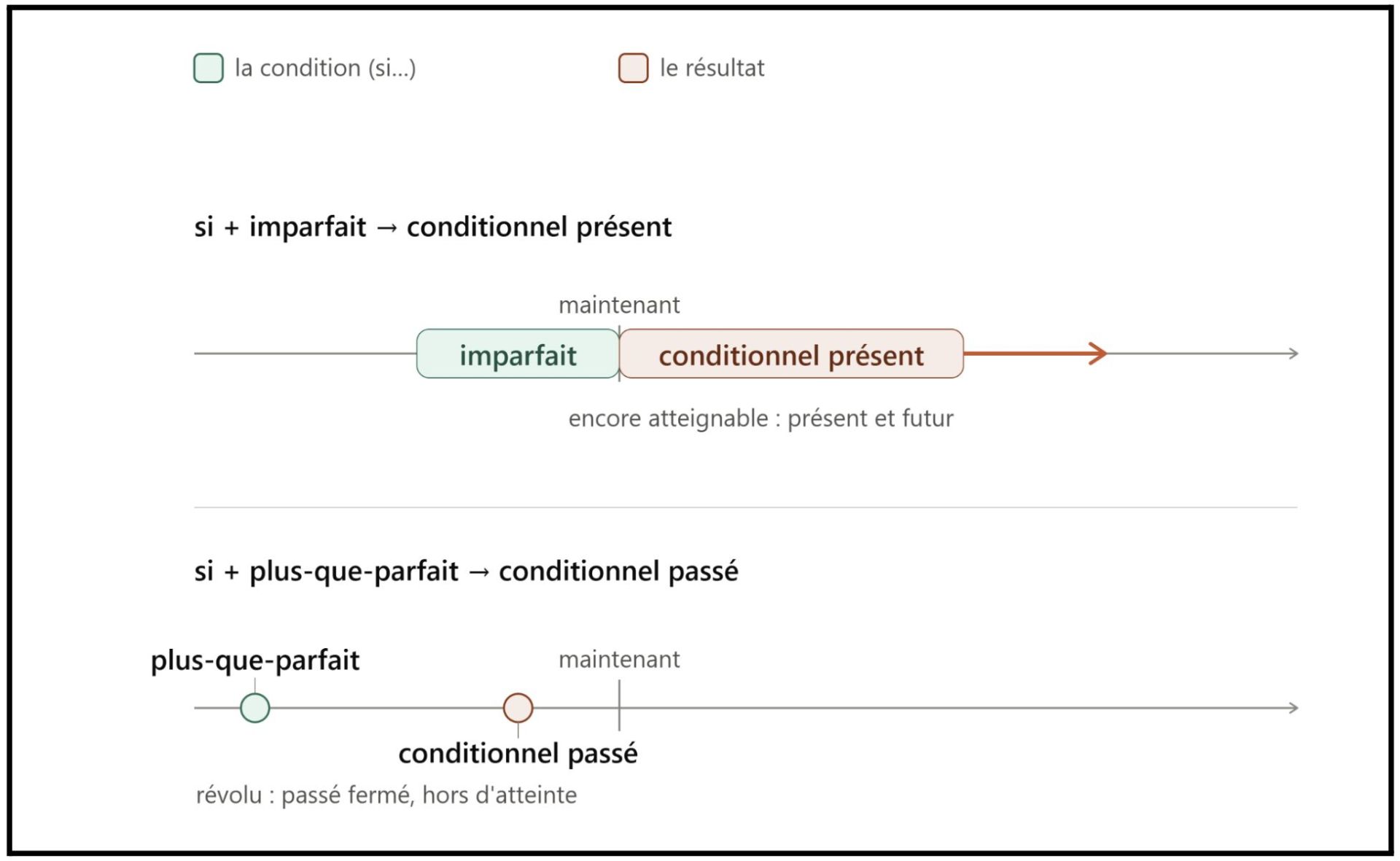
So the difference a learner memorizes as a mechanical rule, imparfait in one case and plus-que-parfait in the other, turns out to encode the deepest asymmetry we know.
French marks the difference by counting how many layers of pastness it places between the speaker and the imagined world. One layer for the door still ajar. Two for the door walled shut. When you stop asking how to get the rule right and start asking what the rule is for, this is what you find underneath it.
The closed construction carries something the open one cannot, and the grammar itself explains why. The plus-que-parfait is the tense of greatest distance, the imagined world pushed as far from the real as the structure can push it. That greatest distance is exactly what makes it the tense of regret. Si j'avais su, je serais venu. If I had known, I would have come. And I did not know, and the world in which I came is gone. Anyone who has lived long enough carries a sentence like this one, and it is no accident that it reaches for the tense of maximum distance. The grammar is doing what the feeling does.
But maximum distance cuts both ways. The further a possible world is marked as unreal, the more sharply it throws the real world into relief. Run the same tense in the other direction and it stops being the grammar of loss and becomes the grammar of gratitude. Si les choses avaient été autrement, je ne serais pas ici. If things had gone otherwise, I would not be here, not with these people, not in this life, not as this person. The construction that carries the heaviest regret carries, in the same breath, the plainest thankfulness. It depends only on which of the two worlds you choose to look at: the one that closed, or the one that, by closing, became yours.
A word of caution belongs here, because it is easy to say too much.
French is not installing a philosophy of time inside its speakers, and grammar does not decide how a person thinks. Every language separates the still-possible from the no-longer-possible. English does it too, with would against would have, using the same trick of an added past layer. The distinction is human before it is French. What French does is narrower, and for that reason easier to see. It puts the distinction on the surface, in a clean and regular pattern, where the layers can be counted. It does not build the architecture of time. It holds up an unusually clear map of an architecture that was already there.
That clarity is the whole reason this construction is worth teaching as more than a rule. A learner drilling the sequence of tenses is, without being told, rehearsing the difference between what can still be changed and what can only be understood. The imparfait keeps a hand on the future. The plus-que-parfait closes an account with the past. Between them sits the entire distance a mind can travel from the present moment, measured out in verb endings.
There is one last thing worth noticing, and it is the mood neither sentence uses. Both of them lean away from the present. One reaches toward a future I might still seize. The other turns back toward a past I can no longer touch. These are the two directions in which the mind leaves the present: projection and regret. Only the plain indicative, je viens, asks me to be here at all.